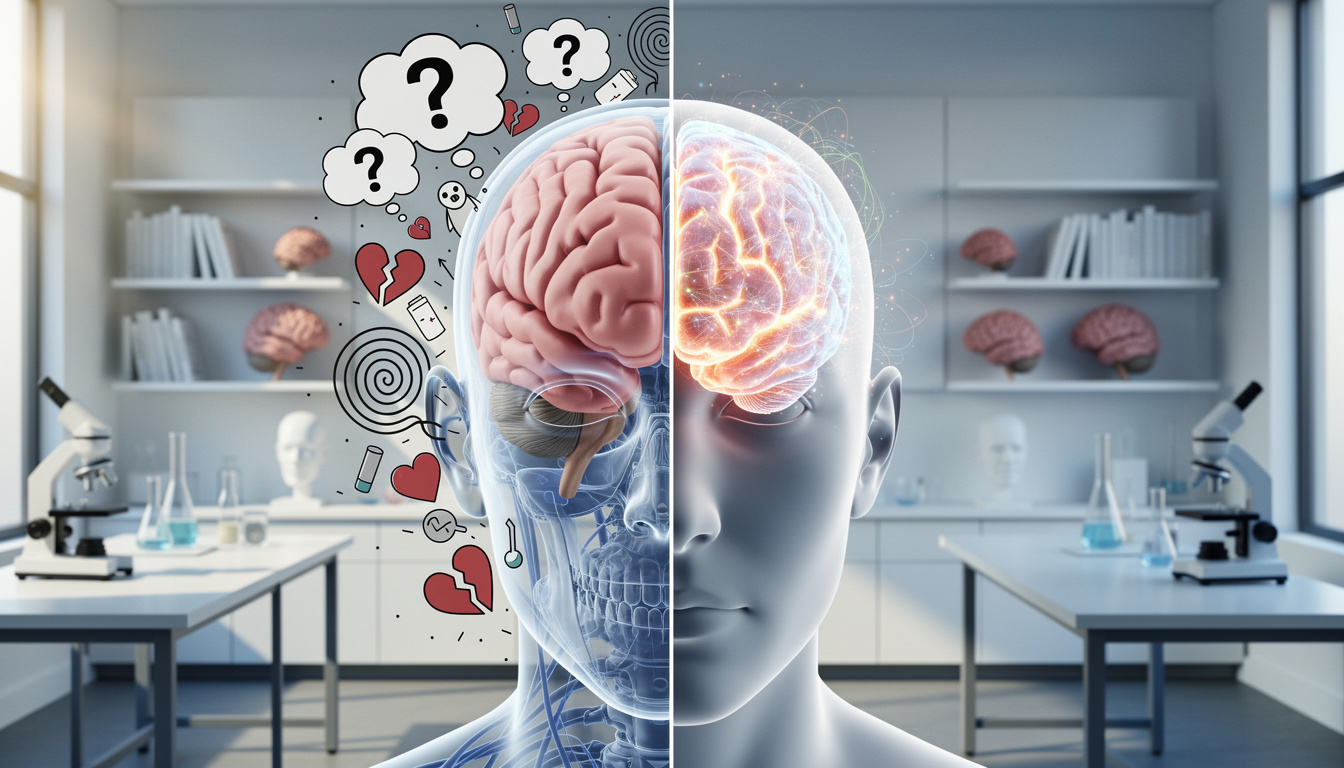
Psychology: this word sparks curiosity, ignites debate, and yet remains shrouded in so many myths! Whether you’re an avid reader of specialized journals, a fan of online quizzes, or simply an observer of a lively discussion, it’s difficult to escape the wave of misconceptions that arises whenever the human mind is explored. In this world where science and belief intertwine, it’s time to lift the veil on persistent cognitive illusions and make way for the rigor of neuroscience. Today, we’re focusing on the most enduring myths in psychology, the scientific explanations behind popular beliefs, and the little tricks that truly make a difference for a healthy mind. From the full moon to hypnosis, from personality tests to charlatans, everything that makes behavioral science enthusiasts shudder or smile is put to the test of demystification!
- 🌕 Full Moon and Mental Behavior : No scientifically proven link
- 🧠 Brain Hemispheres : Brain dominance is a myth 💥 Violence and Mental Disorders
- : Misconception about their danger 🔄 Heredity and Mental Illness : Genetics and Environment, a complex duo
- 🧪 Memory & Hypnosis : Beware of false memories 🎵 The Mozart Effect
- : Intelligence doesn’t increase with music 💔 Therapists and Charlatans : Degrees and controls guarantee ethics
- 🧩 Opposites Attract : Similarity, the secret to lasting relationships Myth or reality? Psychology and behavior under the scientific microscope
- Let he or she who has never heard that a full moon drives people crazy raise their hand! This kind of belief is deeply ingrained in the collective imagination, often passed on without the slightest verification. Yet, no psychiatric study has managed to demonstrate a statistically significant link between lunar phases and mental disorders. Modern research, informed by advances in neuroscience, is unequivocal: the moon doesn’t affect us as much as we think. From emergency room admissions for anxiety to supposedly accelerated childbirth during a full moon, everything has been carefully studied… and refuted. Why then do so many people persist in associating the moon with psychological fragility? Cognitive illusion plays a key role here: our brain loves to make connections… even where none exist. Confirmation bias—those infamous mental shortcuts that lead us to see only what reinforces our beliefs—illustrates how much easier it is to instill a pleasant idea than a sometimes dull scientific truth. While the moon doesn’t affect our mental health, other myths still surround behavioral psychology. Many believe, for example, that seeing a psychologist is only for “the weak” or those lacking strength of character. Yet, taking care of one’s mental well-being requires courage, sometimes more than letting the situation worsen. The very act of seeking help demonstrates clear-sightedness and responsibility, as evidenced by numerous testimonials gathered from specialized centers. Furthermore, believing that psychologists spend their time “analyzing” everything and everyone is a caricature! Certainly, their years of training sharpen their observational skills and their understanding of psychological processes, but in their daily lives, nothing compels them to interpret every gesture or word of those around them. After all, they remain human beings before being walking analytical tools.
- The popular label of “crazy” and its repercussions on mental health consultations Many hesitate to cross the threshold of a psychologist’s office for fear of being labeled “crazy.” This outdated and stigmatizing term betrays an archaic and reductive view of mental health. Consulting a professional today, on the contrary, means acknowledging one’s limitations in order to move forward more effectively, and serious pathologies remain a minority compared to the diversity of difficulties encountered (anxiety, grief, stress, loss of meaning, etc.). To delve deeper into the subject, simply browse the resources on psychology and anxiety management
, which highlight how the demand for mental health support has become normalized in recent years. A little nod to the image of the “passive” psychologist, sitting silently: many modern approaches, such as behavioral therapy or positive psychology, encourage dialogue, collaborative development, and concrete action plans. Moreover, their effectiveness is well-established for many everyday problems!
Common Popular Beliefs, in Light of Neuroscience
Demystifying psychology also means tackling the major myths that have stood the test of time. Take, for example, the persistent legend that each individual has a dominant cerebral hemisphere, the left for “logical” thinkers, the right for “creative” ones. This theory, widely circulated in popular culture and magazines, has been largely refuted. Modern brain imaging, particularly functional MRI, shows that the two hemispheres constantly collaborate, regardless of the task being performed. Cognitive illusions sometimes lead us to believe in simplistic models, where reality is more nuanced. Similarly, the famous “Mozart effect”—the idea that listening to certain types of music can permanently boost intelligence—also falls apart in the face of scientific evidence. While listening to a Mozart sonata can temporarily stimulate certain forms of attention or spatial awareness (for only about fifteen minutes!), no serious research has been able to demonstrate a real impact on the IQ of children or adults.
Here is a comparative table between popular myth and scientific findings: 🧩 Myth🔬 Scientific Reality
We only use 10% of our brain.
Hypnosis = miraculous retrieval of lost memories.
High risk of creating false memories, be careful!
Full moon = agitation, madness.
No scientifically validated correlation.
| Opposites attract. | Similarity fosters lasting relationships. |
|---|---|
| Listening to Mozart makes you smarter. | Temporary effect, no long-term change in IQ. |
| To further explore the origin of these biases, feel free to consult | this article on memory and cognitive psychology. |
| Here you will find examples of illusions and mental shortcuts that deceive even the sharpest minds. | |
| The influence of media and quick tests on the perception of psychology | While the popularization of psychology has sparked public interest in mental health, it also contributes to the spread of misconceptions. Between online personality tests and sensationalist articles, the mix of scientific concepts and generalizing shortcuts sometimes perpetuates confusion. To separate fact from fiction, resources such as |
| this set of validated psychology tests | can be useful to better understand one’s aptitudes, without falling into cognitive illusions or over-psychologizing personality traits. |
https://www.youtube.com/watch?v=SD-gqiWF32gCan we really attribute everything to heredity, the mind, or external influences?
The idea that mental illnesses are systematically transmitted through genes is one of the most persistent examples. Certainly, there is a genetic predisposition to some disorders, but this transmission is neither mechanical nor inevitable. In reality, it is the delicate interplay between genetic inheritance, family environment, life experiences, and social support that shapes each individual’s mental health. Recent research confirms that a healthy environment can neutralize many hereditary risks. This reminds us how much modern psychology relies on the intersection of several disciplines: biology, sociology, neuroscience, and more. In practical terms, the claim that a positive mental attitude is enough to overcome all illnesses, including cancer, is once again a cognitive illusion. While morale plays an important role in quality of life and stress management, there is no scientific evidence that it alone can reverse the course of such serious illnesses. This belief can even be dangerous, as it makes sick people feel guilty when they don’t achieve remission despite their mental efforts.
: Diagnosis influenced by the environment
🙂 The Power of the Mind : Effective for well-being, but not for curing everything 🔍 Bias in the interpretation of traumatic experiences
: Highly malleable memory
- 🔀 The Importance of Support : Psychologist, social support, overall health It is important to remember that human memory offers no guarantee of absolute reliability. Traumatic experiences, far from being “erasable,” can be transformed through therapeutic support, but they never completely disappear. Current practices emphasize the peaceful integration of these memories.
- When positive psychology sheds light on the capacity to bounce back Contrary to preconceived notions, positive psychology has restored a more nuanced image of our ability to bounce back after adversity. Far from “toxic positivity,” it shows that happiness and resilience are attainable, provided we accept reality and rely on our own resources—a point explored in detail on
- this page dedicated to positive psychology. A little nod to those in their forties and fifties: contrary to the belief in an inevitable crisis at this age, it would seem that satisfaction levels increase over time, according to research conducted over several decades!
- Hypnosis, Amnesia, and Memory Illusions: Science Strikes Back Spectacular on stage, often misunderstood in the armchair! Hypnosis has always fascinated and given rise to expectations as great as fears. However, contrary to what some films and television programs suggest, hypnosis does not reliably recover lost memories. On the contrary, the hypnotic state exposes one to a significant risk of creating “false memories,” as numerous studies demonstrated around the turn of the millennium. The influence of the therapist, the suggestibility of the patient, and the emotional context all contribute to making memory unreliable in this specific setting. More generally, our brain is constantly working to reconstruct our memories, adapting them to our experiences and current perceptions. Cognitive psychology teaches us that we do not retain a faithful copy of events, but—thanks to the brain’s trickery—the latest version of our memories! To delve deeper into these fascinating processes, see the article
on depth psychology and memory.
❓ Common Misconception ✅ Scientific AnalysisHypnosis revives authentic memories
Can generate false memories without external validation
Traumas can be “suppressed”
Therapeutic work aims for integration, not erasure The therapist directs the patient’s memory 100%The patient remains an active participant in their process
| Cognitive Illusion and Memory Manipulation | Why is it so easy to believe in the absolute reliability of our memories? The trust bias, in other words, this tendency to overestimate the veracity of our personal memories, partly explains the phenomenon. Current research encourages caution and critical thinking, relying on external verification techniques when it comes to reliving the past. |
|---|---|
| 🧠 | |
| Reconstructive Memory | : Our past is a constant work in progress |
| 👁️ | Critical Thinking |
: Essential when faced with recovered memories
📝
- The Therapist’s Role : To guide and secure the work on memory Between Alleged Quackery and Rigorous Science: The True Profession of Psychologist
- How many times have we heard that therapists are naive dreamers or con artists in it for the money? This misconception is deeply ingrained, despite years of university training, state diplomas, regular checkups, and mandatory registration with the professional body. In France, the title of psychologist is strictly regulated. Mental health centers even offer free consultations to everyone, far removed from the stereotype of an elitist profession. Many patients are afraid to seek help, fearing they will be “analyzed” with every word. Yet, psychology professionals practice active listening and adapt their methods to each individual’s personality and specific issues. Psychology sessions are not simply about sitting on a couch, but about deploying a whole range of tools and individualized support.
- 📚 Recognized training: years of university and certified degrees 💼
Regulated practice: registration with the ADELI register, regular supervision
🏥
Accessible access: public facilities for all, flexible fees
- 🤝 Human connection first: personalization and respect for the patient’s pace To learn more about the fundamentals of practicing psychology, from choosing a course to support methods, helpful advice can be found on
- modern psychology or for those who wish to pursue a career in psychology, the adapted baccalaureate for psychology
- offers a comprehensive guide. The diversity of approaches (cognitive, behavioral, humanistic, etc.) is thus better understood and demystified. Psychology and everyday life: much more than a stereotypical image Psychology is now present in all areas of life. In businesses, schools, and homes, it guides everyone towards well-being, far removed from the clichés of mystery or superficial analysis. To illustrate the richness of this profession, the website dedicates a section to everyday behaviors:
- every action, every emotion, every interaction presents its own set of nuances to explore… with subtlety and humility!
🍀 Daily support: stress management, change management 📈 Constant evolution of practices: updated thanks to science 🤗 Respect and compassion:
The driving forces behind successful support What is the real role of a psychologist compared to common myths? A psychologist is a qualified and recognized professional, trained in listening to and supporting individuals. Their role goes far beyond the clichés that reduce them to a passive role or a couch. He adapts his methods to each patient’s situation and actively participates in demystifying misconceptions through scientific popularization and genuine listening.
- Can we trust memories recovered under hypnosis? Memory under hypnosis is particularly prone to the production of false memories. It is therefore essential to maintain a critical mind, always seek external validation, and work with hypnotherapists who have a solid background in cognitive psychology. Do mental disorders really make people violent?
- No, the vast majority of people with mental disorders are neither dangerous nor violent. Statistically, they are more often victims than perpetrators of violence. Recent studies show that this is an unfounded stereotype that must be actively combated. Does listening to music like Mozart make you more intelligent? No serious study has proven a lasting link between listening to Mozart and an increase in IQ. While music may temporarily improve concentration or attention, it does not influence the structure of intelligence in the long term.
- Is it true that genetics alone determines mental illness? Genetics may play a role, but it is only one of many factors. Environment, education, life experiences, and social network are just as crucial in the development of a mental disorder.