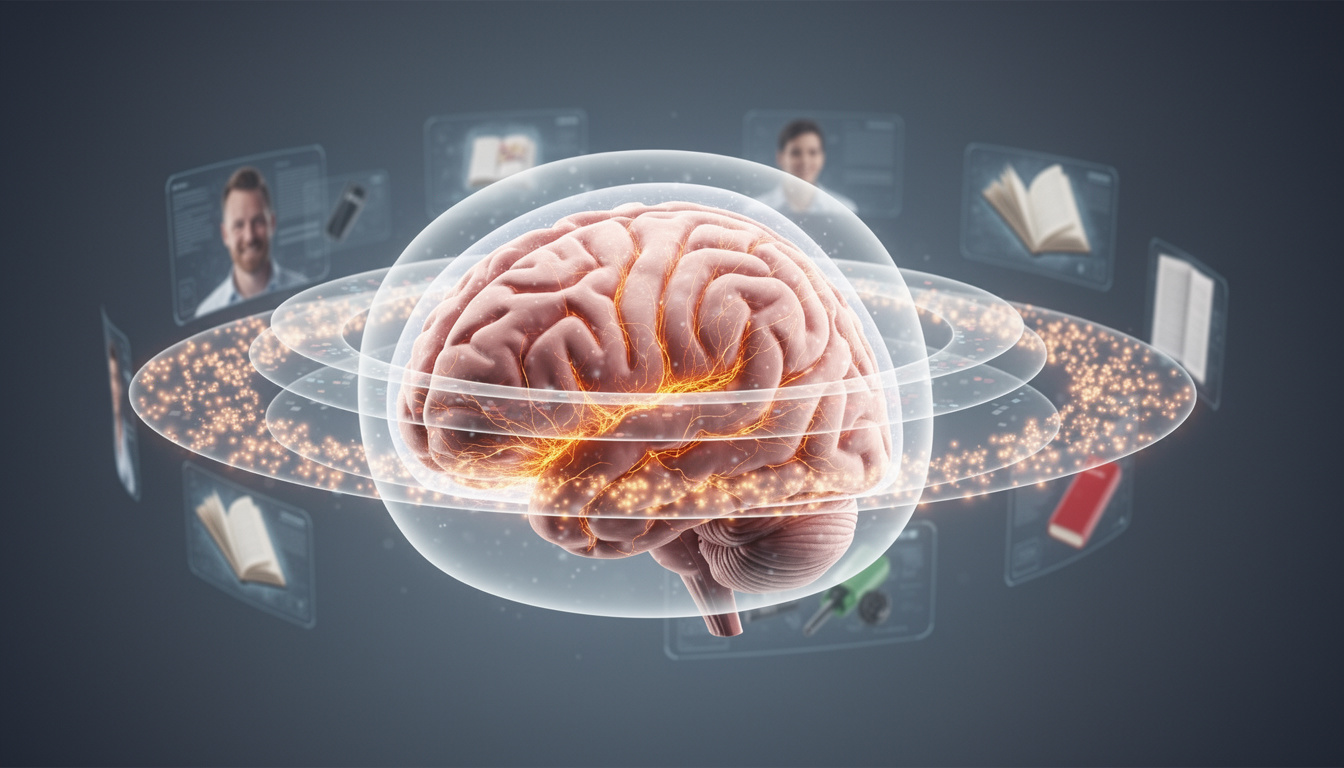
Every day, memory works behind the scenes, orchestrating the management of information that shapes our lives. Recognizing a face, following a conversation, remembering an unfamiliar route, or savoring a childhood scent: these are just some of the feats accomplished thanks to extraordinary memory processes. But behind this apparent simplicity lie dazzling memory mechanisms, combining encoding, information storage, and retrieval, and dependent on fascinating neural networks. Understanding the cognitive psychology of memory means unveiling a system as precious as it is adaptable, essential to our learning, our identity, and our ability to thrive in a constantly changing world. Discover what current science reveals about the secrets of memory and how to take care of this invaluable asset to remain agile as the years go by.
- 🧠 Memory is a set of dynamic systems, including working memory, episodic memory, semantic memory, and procedural memory.
- 💡 Encoding, storage, and retrieval form the three main key stages of the memory process.
- 🌙 Sleep, attention, and emotions play a crucial role in memory consolidation.
- 🔁 Forgetting is a natural mechanism that contributes to our brain’s performance: it sorts, selects, and protects our cognitive efficiency.
- 📋 Practical techniques (visualization, spaced repetition, creating routines) can strengthen your memory on a daily basis. The different types of memory in cognitive psychology: overview and concrete examples
Cognitive psychology breaks down memory into several complementary systems, each specialized in different functions. These memory systems constantly interact to allow us to manage the incessant flow of information. To illustrate how they work, imagine a student named Emilien: he’s taking a new course, remembers his professor’s name, recalls an anecdote from class, and mentally manipulates a list of definitions. Behind his performance lie a multitude of memory types, essential to his success.
Working memory comes into play to keep information in mind for short periods. For example, Emilien remembers an instruction or a room number for a few seconds, just long enough to act. He uses his working memory when he does a mental calculation or organizes an impromptu speech. This system relies on the prefrontal cortex, a brain area heavily involved in active intellectual tasks.
Then, episodic memory
builds and stores personal memories. When a student recalls their first oral presentation or visualizes the room of their last exam, it’s the episodic memory circuits that are activated: they link various elements (places, dates, emotions) to reconstruct a single memory. This type of memory is highly dependent on the hippocampus, a key brain structure, as well as on the emotional state during memory encoding.
Semantic memory stores general knowledge: names of capital cities, abstract concepts, or specific vocabulary. It helps Émilien remember that Paris is the capital of France, or explain the meaning of a technical term. Located primarily in the temporal cortex, this type of memory is the result of numerous and gradual learning experiences.
It’s difficult to imagine daily life without procedural memory This system records automatic behaviors and acquired practices: writing, driving, and playing the piano become natural gestures, performed without consciously thinking about the steps. These motor memories primarily involve the basal ganglia and the cerebellum. Thanks to this type of memory, a skill, even one acquired in childhood, will resurface spontaneously years later.
Finally,perceptual memory
manages the first sensory imprint: the timbre of a voice, the notes of a perfume, or the instant recognition of a familiar sound. These last only a few seconds but play a key role in directing our attention toward what is worth remembering.
- The interactions between these systems form a subtle and evolving balance, modulated by sleep, emotion, repetition, and various everyday factors. Moreover, several disorders can affect these memories, such as cognitive disorders impacting memory and attention,
- whose symptoms are increasingly well-detected today. Concrete examples of different types of memory
- 📝 Remembering a shopping list while waiting to arrive at the store: working memory
- 🎂 Remembering a childhood birthday: episodic memory
- 🌍 Knowing that water boils at 100°C: semantic memory
🚴
🔊
Recognizing the sound of a received message: perceptual memory
This overview is the first key to understanding the fundamental role of cognitive psychology in the study of human memory.
https://www.youtube.com/watch?v=4dv9KaWhN4s
Memory mechanisms: encoding, storage, retrieval, and forgetting Delving into the cognitive psychology of memory means exploring the sophisticated steps that transform fleeting information into a lasting memory. Three major memory mechanisms come into play: encoding, storage, and retrieval (or recall), each crucial for a memory to persist beyond the immediate moment.Encoding: The Gateway to Memories
It all begins with encoding. When Émilien attends a lecture, he selects certain information from the multitude of stimuli. Attention acts like a spotlight, highlighting what will be retained. The prefrontal cortex directs encoding, in collaboration with the sensory areas that capture sounds, images, smells, and more. The level of attention, motivation, and especially the meaning attributed to the information determine the effectiveness of encoding.
Information Storage: Retaining for Better Use
After encoding comes information storage. Depending on the nature of the content, different brain areas are involved. General knowledge (semantic memory) engages the temporal cortex, while personal memories (episodic memory) are entrusted to the hippocampus. Repetition, but especially sleep, plays a crucial role in consolidating these memories. It is proven that sleeping after learning promotes better knowledge retention, and several medications, such as those discussed in the section on sleep treatments, are being investigated for their potential to maintain restorative sleep conducive to storage. Recall and forgetting: selection, competition, and adaptability
| Recall involves reactivating a stored memory. This can be immediate or occur long afterward, depending on the level of consolidation. But forgetting, far from being an enemy, is a precious guardian: it allows us to erase the superfluous, thus freeing up mental space for new learning. Sometimes, similar memories compete, making them more difficult to recall. Cognitive psychology reminds us that forgetting is generally not synonymous with disorder, but rather with the natural selection of what truly matters. | Certain contexts, such as chronic stress or cognitive overload, can disrupt encoding and recall. Recent studies highlight the link between stress, sleep quality, and memory vulnerabilities, while emphasizing the importance of managing emotions to preserve these valuable capacities. Stage | Major Brain Area | Main Role |
|---|---|---|---|
| Example | Encoding 🔍 | Prefrontal Cortex | Active Information Selection |
| Paying Attention to an Explanation in Class | Storage 📦 | Hippocampus, Temporal Cortex | Long-Term Memory Storage |
| Retaining the Definition of a Concept | Recall 🎯 | Associative Networks | Retrieving and Activating the Memory |
| Remembering the Name of a Former Classmate | Forgetting 🛡️ | Inhibitory Networks | Erasure of Unnecessary Data |
Forgetting a Fleeting Code
The Fundamental Role of Emotions, Sleep, and Context in Memory Consolidation
Memory consolidation is the art of transforming “fresh” information into a stable memory, ready to be recalled even years later. This delicate process relies on the interplay of several factors: sleep quality, emotional intensity, context, and repetition. Sleep, a natural ally in memory consolidation
Quality sleep at night strengthens neural connections and stabilizes learning. Researchers have shown that deep and REM sleep actively participate in sorting and consolidating memories. During exam periods, a good night’s sleep proves more effective than nightly cramming! Several sleep disorders can hinder this process, hence the growing interest in solutions such as
Gabapentin and Pregabalin , which also act on anxiety and emotional regulation.Emotions and memory: an inseparable combination
Why do some memories remain etched forever? One of the major answers in cognitive psychology: emotion. A memory linked to intense joy, surprise, or fear will be all the more firmly fixed if the amygdala (the brain’s “emotional center”) stimulates the hippocampus. Significant events—positive or negative—thus leave lasting traces, sometimes at the cost of intrusive memories that can be mitigated with medications such as prazosin, used to soothe traumatic memories.
Repetition, context, and lasting anchoring.
Learning is (also) about repetition. Spaced repetition consolidates memory traces and limits gradual forgetting. Another key: the learning context. Information learned in a familiar environment will be more easily retrieved if the context is repeated when recalling it. This discovery explains why some students remember their lessons better… in the classroom than at home!
- The importance of environment and routine
- 🛏️ Regular sleep to anchor important memories 🎶 Memorization facilitated by a consistent sensory environment
- 🤩 Enhancing information by associating it with an emotion 🔁 Repeating differently to strengthen neural connections
- By helping to better understand these factors, cognitive psychology offers highly effective tools for optimizing learning and intellectual flexibility at any age.
When Memory Fails: Factors of Fragility, Forgetting, and Memory Disorders
However efficient it may be, memory is not infallible. It fluctuates with age and physical condition, and sometimes succumbs to the effects of time. Moments of fatigue, stress, or intense emotions can lead to lapses, without necessarily indicating a serious disorder. But there are also pathologies, cognitive disorders, or genuine memory failures, which are the subject of intense research in cognitive psychology.
Forgetting: A Natural and Protective Phenomenon
The brain is constantly forgetting. This forgetting mechanism, far from being an enemy, protects against information overload and prevents memory from being overwhelmed with useless information. Unrepeated, unemotional, or poorly encoded data fades away to make room for what is essential. This explains why we can forget an insignificant detail while retaining a very old, emotionally charged memory.
Between Normal Variations and Pathologies
Certain periods in life make memory more fragile, particularly old age, exposure to intense stress, or significant depressive episodes. Excessive stimulation (digital multitasking, constant notifications) fatigues the system and reduces the quality of recall.
Specific disorders also exist, such as amnesic disorders or states of cognitive decline, which require targeted support. Some psychotropic medications, such as Modafinil, are being researched to support impaired cognitive functions.
Degenerative diseases like Alzheimer’s or certain brain injuries impair memory by directly affecting the networks responsible for encoding and retrieval. However, fortunately, not all “memory lapses” are indicative of illness: they are often normal fluctuations or responses to the environment.
- Adulthood remains synonymous with stability for long-term memory, even if short-term memory, sensitive to mental workload, can give the illusion of early decline. The key is to remain vigilant for persistent signs and consult a professional in case of sudden or debilitating changes.
- 🧩 Forgetting due to lack of repetition or interest 😨 Impairment after an emotional shock or trauma
- 💊 Influence of certain medications and medical conditions on memory 🖥️ Cognitive overload and digital distraction
- By paying attention to these fluctuations, it becomes easier to act early, adapt routines, or consider targeted interventions to preserve cognitive sharpness. Boosting, maintaining, and stimulating memory daily: methods, exercises, and concrete guidelines Taking care of your memory is ultimately about cultivating an inner garden. Neuroscientists now agree that most brains retain a high capacity for plasticity, even in adults and seniors. There are many fun and engaging tips from cognitive psychology: they combine brain exercises, lifestyle adjustments, and attention-grabbing games.
Exercises and Strengthening Strategies
Diversifying activities stimulates the brain: learning a language, varying your hobbies, and listening to new music all encourage the development of new neural networks. Visualization—associating each piece of information with a striking image—also improves memorization: transforming an abstract concept into a mental image reveals the ingenuity of the human brain.
An effective technique to integrate into a routine is to repeat information at increasing intervals (the principle of spaced repetition, endorsed by many learning apps). Teaching, or explaining a concept to someone, also consolidates knowledge.
Taking care of your brain holistically
A daily routine punctuated by physical activity (walking, dancing, gardening), a diet rich in antioxidants (berries, green tea, omega-3 fatty acids), and gentle stress management (meditation, heart coherence) promotes optimal memory at any age. Certain tools, such as tianeptine, are being explored for people with anxiety or depression to protect cognitive abilities. https://www.youtube.com/watch?v=vHvX9YSoh2Q
- 📚 Active reading and a memory journal to keep track of learning 🎶 Regularly discovering new cultural activities
- 💤 A stable and restful sleep routine 👥 Training through teaching, sharing, and discussion
- Memory tip Explanation
- Emoji Visualize information
- Create a vivid mental image for each new piece of information 🖼️
| Repeat at regular intervals | Review concepts a few days after learning them, and then again | 🔄 |
|---|---|---|
| Establish a routine | Set specific times to review or reactivate knowledge | ⏰ |
| Move every day | Ensure a minimum of physical activity to oxygenate the brain | 🚶♂️ |
| Share with others | Pass on knowledge to another person to solidify your own learning | 🤝 By embracing new experiences and taking care of your overall health, everyone can become an active participant and protector of their memory, an essential resource for all personal and professional development. |
| What is the difference between short-term and long-term memory? | Short-term memory retains information for a few seconds to a minute – like a phone number you just heard. Long-term memory, on the other hand, retains information permanently, over months or years, after a process of encoding and then consolidation. | Can emotions influence memorization? |
| Yes, emotions play a key role: information received in a strong emotional context is better encoded and consolidated, and will be more easily recalled later. This is why happy, sad, or significant memories remain present over time. | How can we minimize forgetfulness in everyday life? Spaced repetition, creating visual associations, and establishing learning routines are very effective strategies. Maintaining a healthy lifestyle (sleep, diet, stress management) also supports memory performance. | Is stress a factor in memory problems? |
Chronic stress impairs the encoding and retrieval of memories due to increased cortisol production, which disrupts the hippocampus. It is therefore important to learn to regulate your emotions and to seek professional help if stress becomes chronic.